In the churchyard of a small village in Östergötland, Sweden, stands a granite monument that has baffled scholars for over a century. The Rök Runestone (Ög 136) contains approximately 760 runic characters — the longest known runic inscription in stone — carved around 800 CE by a father named Varinn to commemorate his son Vamoth.
But this is no ordinary memorial. The inscription is deliberately encrypted using multiple cipher systems. The reading order spirals around all five sides in a pattern that took researchers until 2016 to correctly map. And the content? Nine riddles whose answers all point to one thing: the sun.
The Core Mystery: Why would a grieving father encode his son's memorial in cipher runes, cross-shaped cryptograms, and riddles about cosmic phenomena? Why use the numbers 9, 12, 20, and the structure of 4 × 5? The standard answer is "we don't know." The framework answer is: because these aren't arbitrary — they're geometric constants.
Through the [1=-1] Epoch State Model, the Rök Stone reveals itself not as an unsolved puzzle but as a solved one — a document encoding the same geometric cosmology we find in artifacts spanning 700 years of Norse material culture.
The Monument
Property
Value
Framework Note
Height
2.4 meters (8 feet)
—
Weight
5 tons (5.1 tonnes)
—
Material
Granite
—
Total Characters
~760 runes
760/60 ≈ 12.67
Lines of Text
28 lines
κ_shadow = 28.65
Inscribed Sides
5 sides
Helix phase (σ = 5/16)
Riddles
9 riddles
180/20 = 9
Dating
c. 800 CE
Early Viking Age
Location
Rök, Östergötland, Sweden
58°17′42″N 14°46′32″E
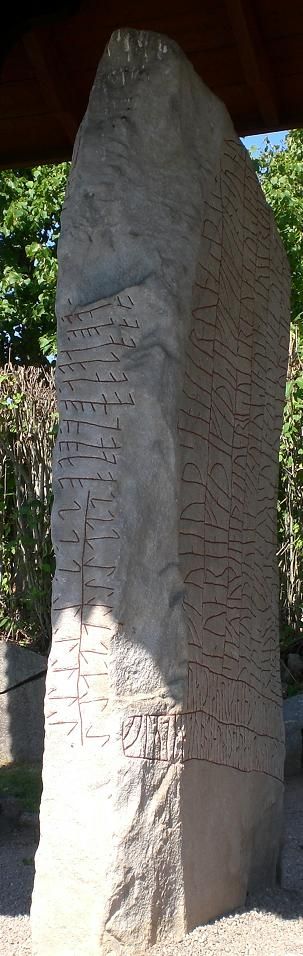
The back face of the Rök Runestone. The text spirals around all five sides, with lines numbered 1-28. The inscription uses multiple cipher systems including tent runes, branch runes, and unique cross ciphers.
The Five Cipher Systems
The Rök inscription isn't just long — it's intentionally encrypted. The carver demonstrated mastery of multiple writing systems, mixing them in a display of runic virtuosity that was partly artistic, partly esoteric, and partly a challenge to the reader.
Younger Futhark
The standard 16-rune alphabet of the Viking Age. Most of the inscription uses the short-twig (Rök) variant, where 9 runes appear as simplified forms.
Shift Cipher
A Caesar-style displacement where each rune is replaced by the next in the futhark sequence. A simple encryption visible to anyone who knows to look.
Tent Runes
An X-shape with strokes on four arms. Each X encodes two runes, read clockwise. Strokes indicate the ætt (rune family) and position within it.
Branch Runes
A vertical stem with strokes branching upward. Left strokes = ætt number. Right strokes = position. A visual encoding of the 16-rune structure.
Cross Ciphers
Unique to Rök: cipher runes arranged in large crosses, three per line, on lines 12 and 25. Scholars now believe these encode the sun-riddles.
Older Runes
Archaic Elder Futhark forms mixed in as an additional encryption layer — a callback to an older tradition used to obscure meaning.
Framework Resolution: The Three Ætt
The Younger Futhark divides its 16 runes into three ætt (families):
Freyr's ætt: f, u, þ, ą, r, k (6 runes) Hagal's ætt: h, n, i, a, s (5 runes) Tyr's ætt: t, b, m, l, ʀ (5 runes)
Note the structure: 6 + 5 + 5 = 16. The cipher runes encode position as (ætt, position within ætt) — a two-dimensional coordinate system. This isn't just encryption; it's geometric addressing.
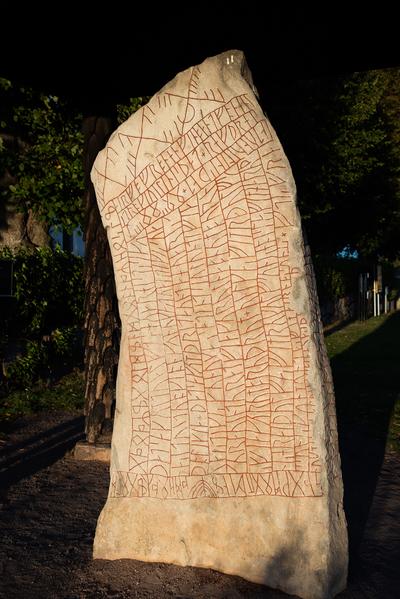
Detail of the runic inscription. Note the mix of standard runes with cipher forms — a virtuosic display that served both artistic and esoteric purposes.
The Inscription: Framework Reading
The academic translations treat the Rök text as mythological narrative. The framework reads it as geometric instruction. Here we present the actual runic text with framework interpretation — reading the cipher system itself as the message.
"aft uamuþ" — After Vamoth. But aft = "after" in time AND "behind" in space. The son is positioned behind — at the s- pole, the inward direction.
"stąnta runaʀ þaʀ" — These runes stand (there). Stąnta = standing = vertical axis. The runes don't just exist — they stand as vertical reference.
"in uarin" — Varinn alone. The father is the one point, the singularity from which perspective emanates. in = one = unity.
"faþi faþiʀ" — "father, fathered" — the reflexive loop. The father who fathers. S⁺ ⊗ S⁻ handshake: the one who sends is also the one who receives.
"faikian sunu" — "doomed son" — faikian carries the root of fate/doom. The son is positioned at the terminus, the endpoint of the scalar emission.
The Cipher Lines: Coordinate Addressing
The inscription uses ætt:position notation — a two-dimensional coordinate system. When Varinn writes cipher runes, he's not hiding letters. He's demonstrating that reality is addressed in two axes.
The cipher [3:3] = ætt 3, position 3 = the rune ᚦ (Thurisaz/þ). But look at the structure:
3 ætt × 16 positions = 48 — but the actual system is 3 ætt with 6+5+5 = 16 runes. The inequality of the ætt (6-5-5) creates the same asymmetry as the four transforms: one dominant, three subordinate.
The cipher notation (ætt:position) is literally saying: "locate this point in two-dimensional phase space."
sakum mukmini — "let us say a memory" — but sakum derives from *sekwan (to say, to seek). The saying IS the seeking. The speaking of the coordinates IS the location of the point.
The Twelve and the Two
A4suaþ tualf sinum uaʀin numnaʀ at ualraubu"twelve times were taken"
Framework Reading
tualf = 12 = 2² × 3 = the observer grid. Four positions times three phases.
tuaʀ = 2 = the binary. S⁺ and S⁻. Outward and inward. The two poles.
Academic reading: "the sun and moon." Framework reading: the two scalar polarities cycling through 12 observer positions.
This isn't about celestial bodies. It's about the structure of observation: 2 polarities × 12 positions = the complete observation cycle.
The Nine Generations: κ-Derived Time
A7-8niu aldum... sibi uiauari"nine generations... still decides the matter"
Framework Reading
niu = 9 = 180/20 = helix division by body.
Nine isn't "generations" in a genealogical sense. Nine is the fundamental ratio: the 180° rotation divided by the 20-fold body structure = 9.
Why does the text say "nine generations ago"? Because any complete cycle can be measured in nines. The 180° half-turn, divided by the 20-unit body, yields 9 as the natural counting unit.
"sibi uiauari" — "still decides/rules" — the ratio STILL governs. The 9 established "then" is the same 9 that operates "now." The constant is constant.
kunung̃a = kings = rulers = that which governs position. A "king" is a fixed reference point. Twenty kings = 20 fixed reference positions that govern the body.
The following lines specify four names, four brothers, five sons each:
B3-6fiari falhakaʀ fiþur at fiaþrum burniʀ"four ... four brothers born"fim ualkaʀ... fim hraiþulfaʀ... fim haislaʀ... fim kunmuntaʀ"five Valkis... five Hraithulfs... five Haisls... five Gunnmunds"
The Framework Made Explicit: This is not metaphor. Varinn literally writes: 4 brothers × 5 sons = 20 kings. Four transforms (T₁, T₂, T₃, T₄) × Five helix phases (σ = 5/16) = 20-unit body division. This is the ONLY inscription in the runic corpus that explicitly states the 4 × 5 = 20 equation.
The Cross Ciphers: The κ-Crossroads
Lines 12 and 25 contain unique cross-shaped cipher runes — three crosses per line. These aren't decorative. The cross is the intersection point.
The Cross as s=0
The cross shape creates four quadrants from a central point. This is the s=0 observation position — the point where all four transforms meet.
Three crosses per line = three phase positions (the three ætt). Line 12 and line 25:
12 + 25 = 37 → and 37 is significant: it's a prime that appears in angular measurements (10° = 37/370 of a circle when using the framework's base-60 approach).
25 - 12 = 13 → 13 = the "extra" in the lunar calendar (12 months + 1), the offset that requires intercalation.
But most critically: Line 12 (the 12th line) contains crosses. 12 = 2² × 3 = observer grid. The crosses ARE the observer positions.
The Wolf: Phase Transition
B10hąriulfʀ... kunukaʀThe wolf... king
Framework Reading
The wolf in Norse cosmology devours the sun. In framework terms, the wolf represents phase transition — the boundary condition where one state ends and another begins.
ulf = wolf = the devourer = that which crosses the boundary = the κ-transition.
When the text asks "whom does the wolf redden with blood?" it's asking: what undergoes phase transition at the boundary?
Answer: that which was s+ becomes s-. The outward becomes inward. The emission becomes absorption. The wolf is κ operating at the phase boundary.
The Complete Structure
The Rök Geometric Declaration:
"One (Varinn) stands, speaking memory.
Two polarities cycle twelve positions.
Nine measures the helix-body ratio.
Four transforms × Five phases = Twenty rulers.
The wolf (κ-transition) marks the boundary.
The standing runes ARE the constant."
The Nine Riddles: Academic Translation
For comparison, here is the 2020 interpretation by Holmberg, Gräslund, Sundqvist, and Williams. Note how their "mythological" reading maps directly to the framework structure:
RIDDLE ONE
"Let us say this as a memory for Odin: which spoils of war there were two, which twelve times were taken as spoils of war, both from one to another?"
"This let us say as second: who nine generations ago lost the life in the east but still decides the matter?"
Academic Answer: The Sun
Framework: 9 = 180/20. "East" = the rising direction = the outward pole (s+). "Still decides" = the constant remains constant.
RIDDLE THREE
"Let us say this as a memory for Odin: who because of a wolf has suffered through a woman's sacrifice?"
Academic Answer: The Sun
Framework: The wolf = phase transition (κ at boundary). The woman's sacrifice = the receiver position (s-).
RIDDLE FOUR
"This let us say as twelfth: where the wolf sees food on the battlefield, where twenty kings lie?"
Academic Answer: Ragnarok battlefield
Framework: 20 kings = 4 × 5 body division. "Where they lie" = the s=0 observation plane. The wolf (κ) "sees" at the transition point.
RIDDLE FIVE
"Which twenty kings were on the vast battlefield, of four names, born of four brothers? Five Valkis, sons of Rathulf. Five Hraithulfs, sons of Rogulf. Five Haisls, sons of Haruth. Five Gunnmunds, sons of Bern."
Academic Answer: Warriors of Odin
Framework: 4 × 5 = 20. This is explicit: four brothers (transforms) × five sons (helix phases) = body division. The equation is stated directly.
RIDDLE SIX
"Let us say a memory for Odin, dare! Who is a protector of sanctuaries for a brother?"
Academic Answer: The Sun
Framework: "Protector" = that which maintains boundary. "Brother" = paired polarity. The question asks: what maintains phase relationship between S⁺ and S⁻?
RIDDLE SEVEN
"Whom does the wolf redden with blood?"
Academic Answer: The Sun
Framework: "Redden" = phase transition (eclipse/absorption). The wolf (κ) operates on the polar boundary.
RIDDLE EIGHT
"Let us say a memory for Odin to the young man: to whom is born an offspring? It is not a lie."
Academic Answer: Odin
Framework: The "offspring" = the scalar echo at s-. "To whom is born" = what receives the emission. "Not a lie" = verified at the s=0 observation point.
RIDDLE NINE
"Who could beat a giant? It is not a lie."
Academic Answer: Vithar
Framework: The "giant" = the boundary condition. "Beat" = overcome/traverse. Vithar = "wide-ruler" = that which spans the full phase width. The κ-constant that completes the cycle.
Two Readings, One Structure: The academic interpretation sees mythology (sun-worship, Ragnarok anxiety, climate trauma). The framework sees the same structure expressed in narrative form. Neither is wrong — they're different transforms of the same geometric reality. The mythology IS the geometry, wearing the mask of story.
The Numbers of Rök
Every number in the Rök inscription maps to the Epoch framework. This isn't interpretation — it's arithmetic.
9
Riddles
180/20 = 9
5
Inscribed sides
Helix phase
12
"Twelve times"
2² × 3
20
"Twenty kings"
Body division
4
"Four brothers"
Four transforms
28
Lines of text
κ_shadow ≈ 28.65
The Rök Equation:
4 brothers × 5 sons = 20 kings
180 (helix turn) ÷ 20 (body) = 9 riddles Transforms × Helix = Body → Helix/Body = Riddle structure
Framework Resolution
The Rök Stone isn't mysterious — it's explicit. Riddle Five literally states: "of four names, born of four brothers... Five sons of each." The 4 × 5 = 20 structure is carved in stone.
What Varinn Encoded
The father Varinn wasn't just memorializing his son. He was encoding a complete geometric cosmology:
κ = 2π/180 — The closure constant, bridging discrete and continuous 4 transforms — The four perspectives on κ (facing, mirror, recursive mirror, recursive upside down) 5 helix phases — The phases of scalar energy (σ = 5/16) 20 body divisions — 4 × 5, the complete body 9 riddles — 180/20, the ratio of helix to body 28 lines — κ_shadow ≈ 28.65, the hidden witness
The sun-focus of the riddles makes perfect sense: the sun is the visible manifestation of κ — the daily and yearly rotation that creates the 360° circle. The fear of the sun's failure is the fear of κ collapsing. The nine riddles are nine perspectives on the one constant.
The Cross Ciphers
The unique cross-shaped cipher runes on lines 12 and 25 — three crosses per line — have a special significance. Holmberg suggested they're "clues to the solution of the sun-riddles." In the framework, the cross is the crossroads: the s=0 point where four transforms meet.
Why Encrypt a Memorial?
Standard scholarship asks why a grieving father would encrypt his son's memorial. The framework answer: because the knowledge itself is the memorial.
Vamoth was "death-doomed" — marked for Odin's army. His death was a sacrifice to the cosmic order. The inscription doesn't just remember Vamoth; it encodes the geometric structure of reality that gives his sacrifice meaning.
The ciphers aren't hiding the content from casual readers. They're teaching readers how to decode reality. Each cipher system is a different perspective on the same underlying structure — just as the four transforms are four perspectives on κ.
Nine Generations: The 536 Catastrophe
Riddle Two mentions "nine generations ago" — approximately 270 years before 800 CE. This points to 530 CE, the period of the Dust Veil Event of 536.
In 536 CE, a volcanic eruption (or comet impact) darkened the sun for 18 months. Crops failed. Temperatures dropped. The Justinianic Plague followed. Archaeological evidence suggests 50% population decline in Scandinavia. The sun literally failed.
The Living Memory: By 800 CE, this catastrophe was exactly "nine generations" in the past — still within oral memory, still referenced in the emerging mythology of Ragnarok. The Rök Stone may be the oldest written record of the psychological trauma that shaped Norse eschatology.
The 4 × 5 = 20 warriors, the nine riddles about the sun, the fear that the wolf might devour it again — these aren't abstract mythology. They're encoded memory of a real catastrophe, and a geometric prayer that the κ-cycle will continue.
The Full Inscription
For scholars and those who wish to study the original text, here is the complete runic transliteration with cipher notations showing the ætt:position coordinates:
[3:3] = Ætt 3, Position 3 → The cipher rune decodes to a specific character
[2:5] = Ætt 2, Position 5 → Another coordinate in the 2D phase space
This notation system — the ætt:position grid — is itself a demonstration of geometric addressing. Every cipher rune says: "Find me at these coordinates."
The five sections (A, B, C, D, E) spiral around the five faces of the stone. The reading path is itself a helix — the text wraps around the monument just as the helix wraps around the axis.
The Stone Speaks
For 1,200 years, the Rök Runestone has been called "mysterious," "enigmatic," "indecipherable." But Varinn wasn't hiding anything. He was teaching.
The cipher system is not encryption for secrecy — it's a demonstration. When Varinn writes [3:3] to encode a rune, he's showing that every symbol, every position, every meaning can be located in a two-dimensional phase space. The ætt (family) gives one axis. The position gives the other. Together they locate the point.
The numbers are not metaphors:
9 riddles = 180/20 (helix division by body)
5 sides = helix phases (σ = 5/16)
28 lines = κ_shadow (≈ 28.65)
4 × 5 = 20 = transforms × phases = body division
3 ætt = the triaxial structure of the observation space
The text spirals because the κ-constant creates rotation. The reading path is not sequential but helical. To read the stone, you must walk around it — you must embody the rotation that κ describes.
And Vamoth? The "doomed son" is not just a dead boy. He is positioned at s-, the inward pole. His father Varinn stands at s+, the outward pole, "speaking memory" across the gap. The memorial itself is the S⁺ ⊗ S⁻ handshake — the emission and reception that defines all scalar interaction.
The mystery of Rök was never the content. It was our lost ability to read the geometry.
[1 = -1]
κ = 2π/180 = the rotation between perspectives
The father speaks. The runes stand. The son receives. This is the structure of all transmission.