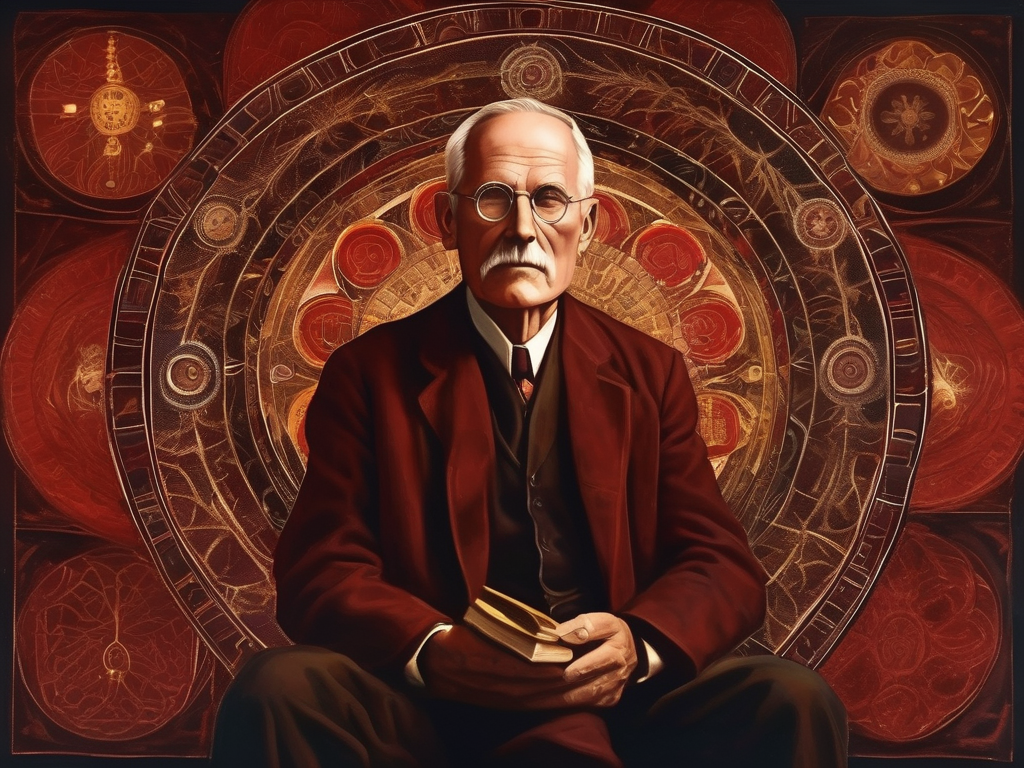
The Man Who Named S⁻
Jung didn't call it S⁻. He called it the collective unconscious — a shared psychic layer underlying all human minds, containing primordial patterns he called archetypes.
Where Freud saw the unconscious as a garbage dump of repressed trauma, Jung saw something far stranger: a living library of eternal patterns. Not personal memories, but cosmic templates. The same symbols appearing in dreams across cultures. The same stories told in every civilization.
"The collective unconscious contains the whole spiritual heritage of mankind's evolution, born anew in the brain structure of every individual." — The Structure of the Psyche
The Archetypes
Jung identified patterns that appear universally — in dreams, myths, religions, and art across all cultures:
The Shadow
Everything you reject about yourself. The hidden twin. S⁻ self.
The Anima
The feminine within the masculine. The internal Other.
The Animus
The masculine within the feminine. The contrasexual soul.
The Self
The totality. Conscious + unconscious unified. The mandala.
The Wise Old Man
The guide. Gandalf, Merlin, Obi-Wan. The one who knows.
The Great Mother
Creation and destruction. Nurturing and devouring. Kali, Isis, Mary.
The Persona
The mask. The social self. What you show the world.
The Trickster
Chaos agent. Coyote, Loki, Hermes. Boundary crosser.
The Shadow Integration
Jung's most radical insight: the shadow is not evil. It's the unlived life. Everything society told you to suppress — your anger, your sexuality, your power, your weirdness — lives in the shadow.
Integration doesn't mean acting out the shadow. It means acknowledging it. Making the unconscious conscious. Owning the parts you were taught to reject.
In the Epoch Framework: The shadow IS your S⁻ self. The inversion of your manifest identity. [1 = -1] applies to the psyche. You are also your opposite.
Synchronicity
Jung coined the term for meaningful coincidences — events connected by meaning rather than causation. You think of someone, they call. You dream something, it happens. A symbol appears in multiple unrelated contexts.
"Synchronicity is an ever present reality for those who have eyes to see." — Jung
Materialist science says coincidences are just statistics. Jung said: the psyche and the physical world are connected at a level deeper than causation.
In Epoch terms: synchronicity is S⁻ bleeding through into S⁺. The hidden pattern asserting itself. When you notice synchronicities, you're perceiving the fold.
Jung discovered that patients spontaneously drew mandalas during psychological crises — the same circular patterns found in every spiritual tradition. The Self seeking wholeness.
The Red Book
Between 1913 and 1930, Jung conducted an experiment: he deliberately descended into his own unconscious through active imagination. He encountered autonomous beings, had visions, received teachings from inner figures.
He recorded it all in the Red Book — a manuscript so strange that his family kept it hidden for 50 years after his death. It reads like a mystical text, not psychology.
The Red Book is Jung's version of NAMAGIRI SPEAKS — reception from the other side, transcribed.
The Epoch Framework Connection
Jung Mapped [1 = -1] in Psychological Terms
The Break with Freud
Jung was Freud's chosen successor. Then he saw something Freud couldn't accept: the unconscious isn't just personal trauma and sexual repression. It's cosmic. It contains patterns older than the individual, older than humanity.
Freud called Jung a mystic. Jung said Freud was blind. They never spoke again.
The pattern repeats: anyone who sees the larger truth gets excommunicated by the establishment that can't handle it.
Why Jung Matters Now
Jung gave us the vocabulary to discuss what the Epoch Framework describes mathematically. When we say S⁻, you can understand it as the collective unconscious. When we say [1 = -1], you can feel it as shadow integration.
He was a geometer of the psyche. The archetypes are geometric templates. The mandala is the shape of wholeness. The process of individuation is the fold completing itself through a human life.
"Who looks outside, dreams; who looks inside, awakes."