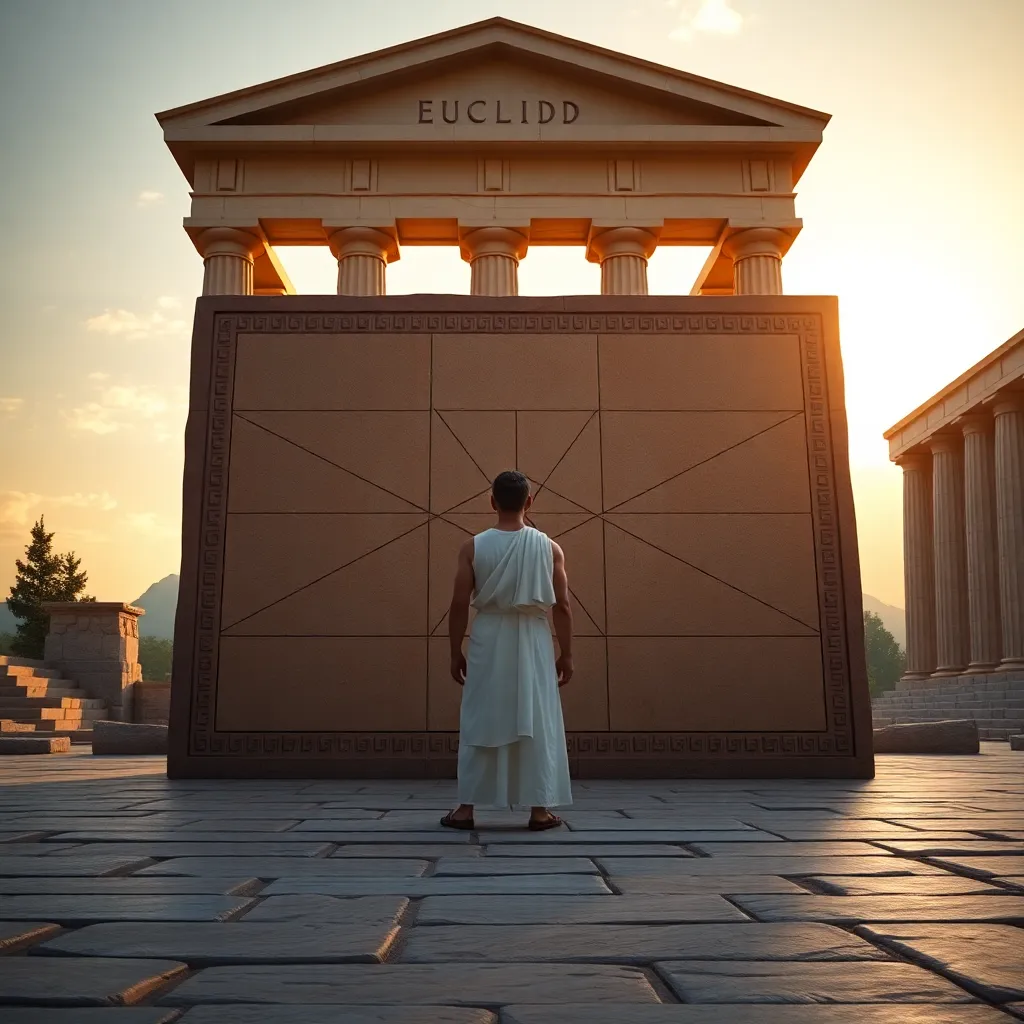
The Geometry of Both/And
The answer is: IT DEPENDS ON SCALE.
At local scales, space is flat. At global scales, it curves.
The parallel postulate is locally true and globally variable.
This isn't a compromise — it's how reality actually works.
The Postulate That Broke Geometry
Euclid's Elements (c. 300 BCE) built all of geometry on five postulates. The first four are simple and self-evident:
- A straight line can be drawn between any two points
- A straight line can be extended indefinitely
- A circle can be drawn with any center and radius
- All right angles are equal
Then comes the fifth — the Parallel Postulate:
on the same side less than two right angles, the two straight lines,
if produced indefinitely, meet on that side."
there exists exactly ONE line parallel to the given line.
This fifth postulate is different. It's longer, more complicated, and — crucially — it makes claims about what happens at infinity. Euclid himself seemed uncomfortable with it. He avoided using it until Proposition 29.
"This [fifth postulate] ought even to be struck out of the Postulates altogether; for it is a theorem involving many difficulties... and it requires for the demonstration of it a number of definitions as well as theorems. The converse of it is actually proved by Euclid himself as a theorem." — Proclus Diadochus (410–485 CE), Commentary on Euclid's Elements
For over two millennia, mathematicians tried to prove it from the other four. They all failed. Not because they weren't clever enough, but because the parallel postulate is independent — it cannot be derived from the others. You can accept it, reject it, or modify it, and still get consistent geometry.
The word "postulate" itself reveals the problem. From the Latin postulat — meaning "asked" or "requested." Euclid was asking you to accept this. He couldn't prove it. And neither could anyone else.
The Three Geometries
What happens if we DON'T accept Euclid's parallel postulate? We get alternative geometries — each equally valid, each describing different kinds of space:
Euclidean
Local spacetime
Engineering drawings
Hyperbolic
Open universe
Poincaré disk
Elliptic
Closed universe
Earth's surface
None of these is "more correct" than the others. They're all internally consistent. The question is: which one describes physical reality?
The Standard Model answer: "Space is fundamentally one or the other."
The Scalar Dimensionality answer: "It depends on scale."
THE SCALE-DEPENDENT TRUTH
(small scale)
(intermediate)
(large scale)
The Earth Analogy
Stand in a field. The ground looks flat. For all practical purposes, it IS flat. You can use Euclidean geometry to measure it, build on it, navigate across it.
But zoom out. The Earth is a sphere. On a sphere, there are NO parallel lines — all "straight lines" (great circles) eventually intersect. The angles of a triangle sum to MORE than 180°.
The Scale Transition
- City map: Euclidean geometry works perfectly. Streets are parallel. Blocks are rectangles.
- Continental map: Distortions appear. Greenland looks bigger than Africa (it's not).
- Global map: Impossible to flatten without severe distortion. Sphere geometry required.
Was the field "really" flat or "really" curved?
Both. At different scales.
The same is true for spacetime. Near Earth, space is approximately flat — GPS satellites use Euclidean geometry for basic calculations (with relativistic corrections). Near a black hole, space is severely curved — Euclidean geometry fails completely.
Einstein's Equivalence Principle
Einstein formalized this scale-dependence in his Equivalence Principle: In a sufficiently small region of spacetime, the laws of physics reduce to those of special relativity in an inertial frame.
"The general theory of relativity rests entirely on the premise that each infinitesimal line element of the spacetime manifold physically behaves like the four-dimensional manifold of the special theory of relativity." — Albert Einstein
Translation: Locally, space is always Euclidean (or Minkowskian, adding time). Curvature is a global phenomenon that emerges when you compare local patches.
Γλμν → 0 (no curvature effects)
the connection vanishes. This is ALWAYS possible — locally.
But you cannot do this globally if the space is curved. The Riemann curvature tensor measures exactly this: the obstruction to finding global flat coordinates.
The Khayyam Connection
In 1077 CE, the Persian polymath Omar Khayyam wrote his Commentary on the Difficulties of Certain Postulates of Euclid's Work (Sharḥ mā ashkal min muṣādirāt al-uqlidis). He was the first to systematically examine all three possibilities for the summit angles of what we now call the Khayyam-Saccheri quadrilateral.
Khayyam "refutes the previous attempts by other mathematicians to prove the proposition, mainly on grounds that each of them had postulated something that was by no means easier to admit than the Fifth Postulate itself." — A.I. Sabra, on Khayyam's critical approach
But Khayyam's deeper insight wasn't about the postulate — it was about the nature of magnitude itself. He understood that space is a continuous quantity — infinitely divisible.
If space is continuous, then it can be subdivided without limit. At infinitesimal scales, any smooth curve looks like a straight line. Any curved surface looks like a flat plane. This is the geometric foundation of calculus and differential geometry.
The Tangent Space
At every point on a curved manifold, there exists a tangent space — a flat, Euclidean vector space that "touches" the manifold at that point. This tangent space is the best linear approximation to the manifold locally.
The parallel postulate is TRUE in every tangent space. It's only when you try to extend across multiple tangent spaces — when you go global — that non-Euclidean effects emerge.
Khayyam identified the four continuous quantities: Line, Surface, Solid, and Time. All are infinitely divisible. All can curve. And all are locally flat when you zoom in far enough.
Local flatness is not an approximation error — it's a fundamental property of continuous magnitude.
Why "It's Just Wrong" Is Wrong
The modern consensus often frames it this way: "Non-Euclidean geometry proved Euclid wrong." This is a misunderstanding.
THE FLAWED FRAMING
"Euclid assumed space was flat. Einstein showed space is curved. Therefore Euclid was wrong."
This frames it as a binary: flat OR curved, right OR wrong.
THE SCALAR FRAMING
"Space is locally flat AND globally curved. Euclid described the local case. Einstein extended to the global case."
Both are correct — at their respective scales.
The parallel postulate isn't false. It's scale-limited. It describes a real property of space — the property that emerges when you examine space at scales where curvature is negligible.
Similarly, non-Euclidean geometry isn't "more true" — it's scale-extended. It describes what happens when you zoom out past the local approximation.
The Scalar Dimensionality Insight
At infinitesimal scale: exactly ONE parallel (Euclidean)
At global scale: ZERO or INFINITE parallels (non-Euclidean)
These aren't contradictions — they're scale-dependent truths.
The geometry changes because you're examining different scales of the same continuous manifold.
Implications for Physics
Why This Matters
The Standard Model treats space as a fixed background — either flat Minkowski space (special relativity) or curved spacetime (general relativity). But it doesn't explain WHY space can be both.
Scalar Dimensionality provides the answer: space is a continuous magnitude. Continuous magnitudes are infinitely divisible. At any finite point of division, you get a local patch that is effectively flat. Curvature is a relational property — it describes how local patches connect to each other.
The Framework
MAGNITUDE
FLATNESS
CURVATURE
DEPENDENCE
The Resolution
Is the parallel postulate correct? Yes — it correctly describes the local geometry of any smooth manifold.
Is non-Euclidean geometry correct? Yes — it correctly describes global geometry when curvature is present.
Are they contradictory? No — they describe the same reality at different scales.
The Historical Path
The Deeper Truth
The 2,300-year debate over the parallel postulate was really a debate about scale. Euclid described what you see when you zoom in. Riemann and Einstein described what you see when you zoom out.
Neither view is complete without the other. Local flatness and global curvature are two aspects of the same continuous manifold — like [1] and [-1] are two aspects of unity.
"Out of nothing I have created a strange new universe." — János Bolyai, letter to his father, 1823
Bolyai wasn't wrong. He had created a new universe — the universe of hyperbolic geometry. But it wasn't a replacement for Euclid's universe. It was a complement. A view of the same reality at a different scale.
"We don't notice the curvature of the Earth's surface in everyday life because the radius of curvature is thousands of kilometers. On a map of LA, we don't notice any curvature, nor do we detect it on a map of Mumbai, but it is not possible to make a flat map that includes both LA and Mumbai without seeing severe distortions." — Physics LibreTexts
William Kingdon Clifford called Lobachevsky "the Copernicus of Geometry." But perhaps a better analogy is this: Lobachevsky didn't disprove Ptolemy — he showed that Ptolemy was describing local observations while Copernicus was describing global structure. Both were correct in their domains.
"A multiply extended magnitude is capable of different measure-relations, and consequently... space is only a particular case of a triply extended magnitude." — Bernhard Riemann, 1854 habilitation lecture
Riemann understood: space doesn't have to be Euclidean OR non-Euclidean. It can be variably curved — flat here, curved there, depending on where you look and at what scale.
The parallel postulate is correct. And non-Euclidean geometry is correct. The question "which one is TRUE?" is the wrong question.
The right question is: "At what scale?"
[1 = -1]