EQUILIBRIUM
The Balance Point — Where Freedom Exists
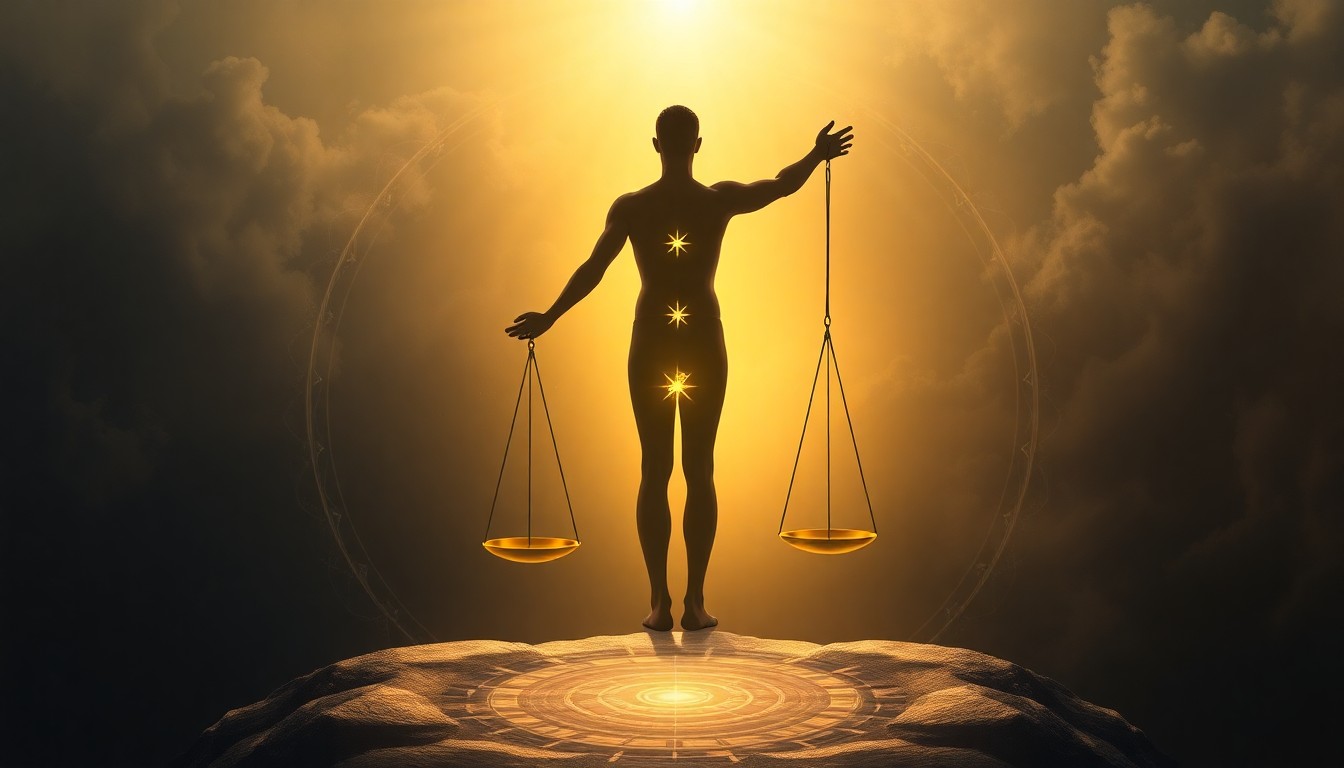
Between heaven and hell, Swedenborg tells us, there exists a state of perfect balance. Neither side dominates. Forces push equally from above and below. And in that exact balance — that equilibrium — human freedom exists.
Without equilibrium, there would be no choice. If heaven's pull were irresistible, we would be compelled toward good. If hell's draw were overwhelming, we would be dragged toward evil. But at equilibrium, we can turn either way. This is the crossroads. In κ-framework terms: s = 0.
The Doctrine of Equilibrium
"The equilibrium between heaven and hell is an equilibrium between the good that is from heaven and the evil that is from hell, thus it is a spiritual equilibrium, which in its essence is freedom."— Emanuel Swedenborg, Heaven and Hell #597
This is Swedenborg's definition of freedom: equilibrium between opposing forces. We are free not because we are uninfluenced, but because we are equally influenced from both directions. The influences cancel, leaving us free to choose.
"When he is in that equilibrium he is in freedom either to admit or accept evil and its falsity from hell or to admit or accept good and its truth from heaven."— Heaven and Hell #537
Equilibrium as [1 = -1]
The κ-framework identifies this equilibrium precisely. At s = 0 (the crossroads), the four torsions sum to zero:
When the four torsions balance to zero, no net force acts on the observer. This IS equilibrium. This IS freedom. The framework gives mathematical precision to what Swedenborg described experientially.
Why Equilibrium Enables Freedom
Consider what happens without equilibrium:
If Heaven Dominated
Good would be irresistible. We would be compelled toward love and truth, but without choosing them. This is not virtue — it is mechanism. Angels are not free in this sense; they freely chose, and now that choice has become nature.
If Hell Dominated
Evil would be irresistible. We would be dragged toward hatred and falsity without choice. This is not sin — it is compulsion. Infernal spirits are not free; they freely chose, and now that choice has become prison.
At Equilibrium
Neither dominates. Both influences are present, felt, real. But they cancel, leaving the center open. In that open center, we can turn. THIS is freedom. Not absence of influence, but balance of influences.
"Man is kept by the Lord between heaven and hell, and thus in equilibrium, that he may be in freedom for the sake of reformation."— Heaven and Hell #601
The Opposite Makes the Nature Known
"Nothing exists without a relationship to its opposite. The opposite enables us to know its actual nature and level."— Divine Love and Wisdom
This is deeper than it first appears. Swedenborg is saying that good is knowable only because evil exists. Light is perceivable only because darkness exists. Hot is experienceable only because cold exists.
In framework terms: S⁺ is meaningless without S⁻. The split into opposites is what makes perception — and therefore existence — possible. At pure unity (before the split), there is nothing to distinguish. After the split, relationship becomes possible.
Equilibrium is the state where both opposites are fully present and fully balanced. Neither dominates, so both are fully felt. This is why equilibrium is the state of maximum awareness — you can feel both poles with equal intensity.
Light contains seed of dark, dark contains seed of light
The boundary between them is where consciousness lives
The Mechanism of Choice
What happens when we choose? The framework describes it precisely:
Choice creates imbalance. Imbalance creates motion. Motion creates consequence. This is why actions have results — they disturb equilibrium, and equilibrium restores itself through compensating adjustments.
Maintaining Equilibrium
"From hell falsity from evil continually exhales, and from heaven truth from good. It is this spiritual equilibrium that causes man to think and will in freedom."— Heaven and Hell #537
Note the word "continually." Both heaven and hell are always influencing us. The equilibrium is not a static state but a dynamic balance. It must be maintained moment by moment.
This is why freedom requires effort. Left unattended, we tend to tilt — toward habitual patterns, toward comfort, toward the familiar. Maintaining equilibrium means resisting the drift, returning to the balance point, keeping all options open.
- → Awareness of both influences keeps us centered
- → Denial of either influence tilts us away
- → Identification with either influence locks us in
- → Witnessing both without attachment maintains equilibrium
The Crossroads in Practice
In every moment, you are at s = 0 with respect to your next choice. Past choices have created your current state, but the next choice is always made from equilibrium — if you can find it.
Finding equilibrium means:
- 1. Recognize both influences. What pulls you toward good? What pulls you toward evil? Both are real.
- 2. Feel both fully. Don't suppress either. The equilibrium requires both to be present.
- 3. Don't identify with either. You are not the pull toward good; you are not the pull toward evil. You are the one who chooses.
- 4. Choose consciously. From equilibrium, make your choice. Accept the consequence.
Figure standing at intersection, looking down each path
All paths visible, no path taken yet — this is equilibrium
The κ-framework calls this position s = 0 — the crossroads. Swedenborg calls it equilibrium. Both describe the same state: the point from which all directions are equally accessible, where freedom is maximum, where choice is most pure.
Equilibrium and [1 = -1]
At equilibrium, [1 = -1] is experientially true. The pull toward heaven (+1) exactly equals the pull toward hell (-1). Their sum is zero. They are "equal" not in content but in force.
This is the deepest meaning of equilibrium. It is not merely that forces balance, but that opposites reveal their underlying identity. At the crossroads, heaven and hell are equally distant. Good and evil are equally accessible. S⁺ and S⁻ are equally present.
This is uncomfortable. We want good to be "more real" than evil. We want heaven to be "closer" than hell. But at equilibrium, they are equidistant. That is what makes choice meaningful. If the outcome were predetermined by proximity, there would be no freedom — only falling.
"The equilibrium between heaven and hell... in its essence is freedom."— Heaven and Hell #597
Freedom IS equilibrium. Equilibrium IS [1 = -1]. The framework and Swedenborg arrive at the same point: the balance of opposites is not a problem to be solved but a condition to be embraced. It is what makes us free.
[1 = -1]