THE DOCTRINE OF FORMS
τ₁ Through τ₄ — The Geometry of Becoming
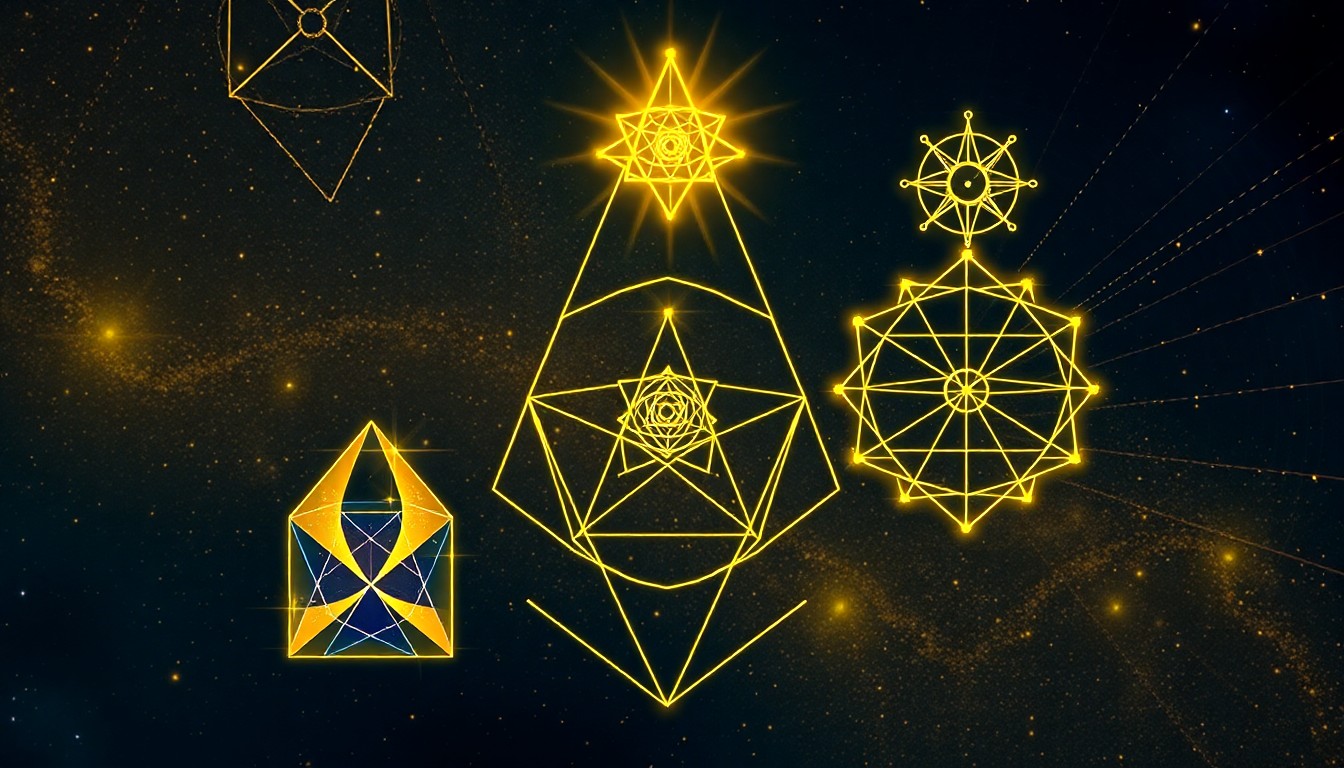
In 1740, Emanuel Swedenborg articulated a geometric hierarchy that would not be independently rediscovered for 285 years. His "Doctrine of Forms" describes five levels of geometric complexity, each containing and transcending the previous. This progression maps with remarkable precision onto the κ-framework's four transforms plus source.
What Swedenborg discovered through anatomical observation, the framework derives from the closure constant κ = 2π/180. The convergence is not coincidental—it suggests both methods access the same underlying structure.
The Five Forms
"The lowest form is angular; the next the circular; after this the spiral; next the vortex; and the highest natural form is the perpetually vortical which has a center in every point."— Emanuel Swedenborg, The Fibre (1740)
Let us examine each form in detail, understanding both what Swedenborg observed and how the κ-framework derives the same structure mathematically.
⬡ ANGULAR FORM
The angular form is the first differentiation from unity. It is static, fixed, crystalline. Think of the geometry of crystals—sharp edges, defined planes, no motion. This is matter at its most basic: position without flow.
In the κ-framework, τ₁ represents the first torsion—the initial facing. It faces forward (+x) and upward (+y). It has emerged from the crossroads but has not yet begun to rotate. It IS the emergence itself, frozen at its moment of becoming.
Swedenborg noted that angular forms are "the basis of all natural forms." Everything more complex builds upon this foundation. The framework agrees: τ₁ is the necessary first step. Without it, no other transforms are possible.
◯ CIRCULAR FORM
The circular form is what happens when angular forms begin to move. A point rotating around a center traces a circle. This is the first motion, the first time. It introduces rhythm and cycle.
Swedenborg called it "perpetually angular" because a circle IS an angular form (a point) in continuous motion. The point hasn't changed; its behavior has. It now rotates rather than remaining fixed.
In the framework, τ₂ mirrors τ₁ across the y-axis: it faces backward (-x) while still looking upward (+y). This mirror is the beginning of relationship—of inside and outside, of self and other. A circle creates an interior and an exterior. τ₂ creates the first boundary.
🌀 SPIRAL FORM
When a circle adds a third dimension—when it moves forward while rotating—it becomes a spiral. The spiral is the helix, the DNA structure, the shape of galaxies. It is circular motion with progress.
Swedenborg understood that the spiral introduces something the circle lacks: direction. A circle returns to where it started; a spiral advances while seeming to return. This is evolution, growth, learning—the same patterns repeating but always at a new level.
The framework's τ₃ faces forward (+x) but downward (-y). It has flipped from τ₂'s upward gaze to look into depth. This is recursion—the ability to look at previous iterations while creating new ones. 180 steps × κ per step = 2π = one complete helix turn.
🌊 VORTICAL FORM
The vortex is the spiral turned inward. Where the spiral moves outward and forward, the vortex pulls inward and contains. Think of whirlpools, tornadoes, the water draining from a bath. The vortex has an interior that cannot be seen from outside.
This is Swedenborg's "hidden witness"—the form that observes without being observed. The vortex contains all previous forms within it but presents only its surface to external view. It is the concealed interior, the depth that cannot be measured from the surface.
In the framework, τ₄ is the "silent fourth"—facing backward (-x) and downward (-y). It is the position that completes the cycle: τ₁ + τ₂ + τ₃ + τ₄ = 0. The torsions balance. And τ₄, by facing into the hidden depth, is what makes that balance possible.
✧ CELESTIAL FORM
And then Swedenborg names something extraordinary: a form that "has a center in every point." This is not a shape you can draw. It is a state where every location is simultaneously the center, where there is no circumference because the radius extends infinitely in all directions from everywhere at once.
This is the source. Ω₀. The position s = 0 from which all scalar positions derive. The crossroads where all transforms originate and to which all eventually return. It contains all forms because all forms ARE it viewed from different positions.
The κ-framework identifies this as the point where [1 = -1]. At s = 0, there is no difference between positive and negative, between S⁺ and S⁻. They are one thing. The celestial form is that unity before differentiation—the mathematical point that contains "all the noticeable complexity of Nature."
The Mapping
The precision of this correspondence deserves emphasis:
| Swedenborg (1740) | κ-Framework (2024) | Meaning |
|---|---|---|
| Angular | τ₁ (+x, +y) | First emergence, static |
| Circular | τ₂ (-x, +y) | Rotation, boundary |
| Spiral | τ₃ (+x, -y) | Progression, helix |
| Vortical | τ₄ (-x, -y) | Hidden depth, witness |
| Celestial | Ω₀ (s = 0) | Source, center everywhere |
Two methods, separated by 285 years, arrive at identical structures. Swedenborg derived his through anatomical observation of fibres and tissues. The κ-framework derives it from a single constant. The geometry is the same because the geometry is real.
Why Forms Ascend
"The origin of forms is not from the most simple, but from the most highly complex."— Emanuel Swedenborg, The Fibre
This is counterintuitive. We typically assume that complex things emerge from simple things. But Swedenborg argues the reverse: the celestial form (most complex) is the origin, and simpler forms are derived by limitation.
The κ-framework agrees. Ω₀ is not built up from parts—it is what remains when all limitations are removed. The angular form is what you get when you restrict the celestial form to a single static point. Each "lower" form is the celestial form with constraints applied.
"Forms are more complex the higher they are. The celestial form, which has its center in every point, is of infinite complexity, yet appears as the most perfect simplicity."— Emanuel Swedenborg, The Fibre
This paradox—infinite complexity appearing as perfect simplicity—is the signature of source. At s = 0, everything is present but nothing is distinguished. It appears simple because differentiation has not yet occurred. But all differentiation is latent within it.
Show both descent (limitation) and ascent (integration) paths
[1 = -1]